Posts

Introduction to Critical Zone Observatories and Watershed Sites.

  Dear Watershed Science Community,   The  Early career network-of-networks team  is pleased to announce the Fall 2021 Webinar series on  Introduction to Critical Zone Observatories and Watershed Sites . This webinar series hosted by CUAHSI will occur every Tuesday from August 24 till September 28 at 9:00 AM Pacific Time. The goal of the series is to discuss ideas and brainstorm on ways to enhance collaboration and integration across different international critical zone observatories and watershed sites. The webinars will include several researchers from watershed science and critical zone communities. Read more about this effort  here .   The first webinar will be held on  August 24th, 2021  9 am Pacific and provide an introduction to the montane sites across the world. Confirmed speakers for the first webinar include Susan Hubbard (Berkeley Laboratory), Holly Barnard (CU Boulder), Steven Holbrook (Virginia Tech), Antonello P...

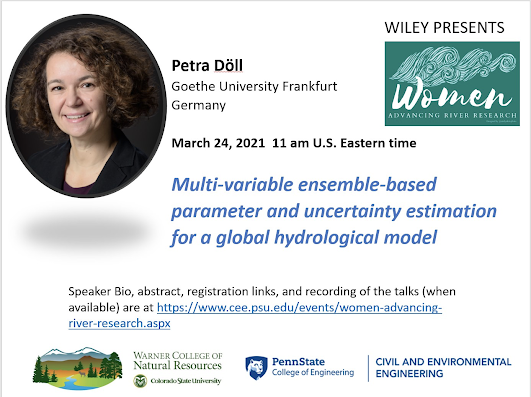
3rd seminar in the Women Advancing River Research series

Image
 

Introduction to Uncertainty, Transparency and Robustness in Socio-Environmental Systems Modeling and Assessments

  Dear iEMSs members Please see the announcement below for the second webcast in this grand challenges series. Sondoss Elsawah gave the first one last Wednesday and it went very well (except for a couple of technical issues that didn’t arise in the practice).   We are also asking Board members to write up a report on each webcast for SESMO, which will also provide a link to the actual paper in SESMO from which the work derives and to the recording of the webcast. Jennifer Koch at OSE is leading a report team on the first webcast.     Best wishes Tony     Free open-access downloads: Springer book on: Integrated Groundwater Management   http://link.springer.com/book/10.1007%2F978-3-319-23576-9 Future of Sensitivity Analysis   https://www.sciencedirect.com/science/article/pii/S1364815220310112 Next Generation Modeling of Water Quality   https://agupubs.onlinelibrary.wiley.com/doi/10.1029/2020WR027721 Eight Grand Challenges in Socio-Environmental...

Virtual Water Gallery

  Good day Cryolister,     Please join us for the launch of the Virtual Water Gallery on Thursday, April 29 from 10:30 -11:30 am CST (UTC-6).   Water is life and so water-related challenges affect everyone. We believe that sharing water perspectives across communities can help find creative and holistic solutions to the water challenges we all face.   The Virtual Water Gallery is a science and art pilot project that brings together artists, water experts, knowledge keepers, and the pubic to collectively reflect on pressing water challenges. As part of this pilot project, 12 artists were paired with 16 water experts and knowledge keepers to co-explore specific water challenges in various Canadian eco-regions and river basins, including the Arctic, the mountains, boreal forests, prairies, farmlands, lakes, rivers, and communities. These collaborations have led to the co-creation of science-art pieces that will be exhibited online on the Virtual Water Gallery. ...

Steepest Descent Meeting 2021

  Dear colleagues,    Registration for the upcoming Steepest Descent Meeting 2021 is now open!  You can register for the meeting and view the meeting schedule on the Steepest Descent website: https://sites.google.com/site/steepestdescentmeeting . Please note that registration is free, but is limited to 500 participants.  We look forward to seeing you there! The Steepest Descent Organizing Team,         Fien De Doncker, Eric Deal, Lizzie Dingle, Erica Erlanger, Benjamin Lehmann, Luca Malatesta, Sarah Mosser, Duna Roda-Boluda

Isotope Tracers in Catchment Hydrology

  We are once again running our Isotope Tracers in Catchment Hydrology course, designed as a national graduate level course (accessible to all Canadian students for credit), but also available to professionals. The course will run from May 10 through 14 online. All of the details pertaining to the class can be found on our class website:  https://water.usask.ca/hillslope/teaching/isotope-tracers-in-catchment-hydrology.php   All are welcome, and participants from outside academia and Canada are encouraged to enrich the discussion.   Hope to see you there, Trish (on behalf of course instructors)   Dr. Tricia Stadnyk, P.Eng. Canada Research Chair Tier II (Hydrologic Modelling) 2020 Killam Laureate   Associate Professor University of Calgary 2500 University Dr NW ESB 458 Calgary, AB  T2N 1N4 Canada W: +1.403.220.6586 M: +1.204.230.3649 Tricia.Stadnyk@ucalgary.ca https://ucalgary.ca/labs/hydrological-analysis/home @h2obabyts  

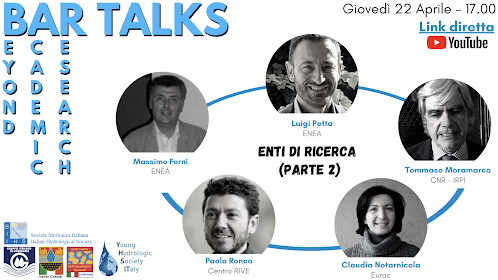
Beyond Academic Research (BAR) Talks

Image
  The Beyond Academic Research (BAR) Talks are organized by the Young Hydrological Society - IT.  It was a excellent series of event in five webinars to bring young hydrologists or aspiring such  to know the world of hydrological opportunities in Italy as developed by small and medium business and the experience of other young researchers.  The YouTubeVideo are very interesting (unfortunately in Italian). It cannot escape to the attention to the reader that they suggest many possible ways of interactions between researchers and the "real world" of the profession of hydrologist in Italy.  BAR Talks - R&D in small and medium companies in Italy  i BAR Talks - R&D in big multinationals companies BAR Talks -Young researchers experiences BAR Talks -  Research Institution (Part I) BAR Talks -  Research Institution (Part II)

If you don’t like the stream power law, wait until you get a load of what we do on hillslopes

Dear All, We are very pleased to announce our next online Landscapes Live seminar by Simon Mudd (University of Edinburgh) that will occur this week on Thursday March 25th at 3pm GMT (4pm CET/8am PDT/11am EDT). The title of Simon's talk is: If you don’t like the stream power law, wait until you get a load of what we do on hillslopes You can register in advance for this Zoom meeting here: https://us02web.zoom.us/meeting/register/tZMtcOqupjgvG9e_8EtvoVQbxFfF-R17pPh5 After registering, you should receive a confirmation email containing information about joining the meeting. We will also post the Zoom link for this meeting on the seminar website: https://osur.univ-rennes1.fr/LandscapesLive/ Abstract: In this presentation I will explain how I don’t understand anything about hillslope morphology. I was drawn to this topic 20 years ago because of some elegant equations that predicted hilltop convexity. It made me feel like an intellectual to say “did you know hillslopes can be des...

Multi-variable ensemble-based parameter and uncertainty estimation for a global hydrological model

Image
 

PhD position on ice age modeling in Antarctica at Grenoble (France)

  Dear Cryolist members, We have a vacant PhD position on ice age modeling in Antarctica, funded by the European ITN project DEEPICE: https://emploi.cnrs.fr/Offres/Doctorant/UMR5001-VALLAN0-052/Default.aspx?lang=EN The conditions are good (good salary, cheap subscription fees at univ.) and the DEEPICE students are part of a European network. I would be glad if you could forward to potential candidates. The current deadline is April 5h, but it might be extended. Thanks and all the best, Frédéric Parrenin

"Experimental Methods and Laboratory Instrumentations in Hydraulics"

  The Institute of Geophysics of the Polish Academy of Sciences, in collaboration with the International Association for Hydro-Environment Engineering and Research (IAHR) Committee on Experimental Methods and Instrumentation and the IAHR Poland Young Professionals Network, is organizing a   webinar focused on  EXPERIMENTAL METHODS AND LABORATORY INSTRUMENTATION IN HYDRAULICS . The webinar will be held online in the mornings (8.30-13.30 CET) of April, 13-15.  Additional information on the final programme and the platform will be available at a later stage via the webpage  https://www.igf.edu.pl/webinar.php The registration is free of charge:  https://www.eventbrite.it/e/experimental-methods-and-laboratory-instrumentations-in-hydraulics-tickets-142745316083

Landscapes Live Thursday 25th February: Allison Pfeiffer

  Dear all, We are very pleased to announce our third  “Landscapes Live”  online seminar of 2021 by  Allison Pfeiffer  (Western Washington University) that will occur this week on  Thursday 25th February at  7 am PST / 10 am EST / 3 pm GMT / 4 pm CET  on: “ Sediment supply controls river bed (in)stability in the Pacific Northwest   ” Abstract: Gravel river channel beds aggrade and incise through time via the process of coarse sediment transport and in response to temporal variation in the upstream supply of water and coarse sediment. However, we lack a thorough understanding of which of these (high flow events or sediment pulses) is the dominant driver of channel bed elevation change. This lack hampers flood hazard prediction, as changes to the bed elevation can either augment or reduce flood heights. In this talk, I will explore the drivers of channel change using multidecadal time series of river bed elevation at 49 United States ...

Cryospheric Models useful in the High Mountain Asia (HMA)

  ​ Dear Cryolist members,     I hope you can join us for the upcoming CDHM Webinar-10 next Friday 26th,7 pm Nepali Time (+5:45 GMT).     Dr. Rijan Bhakta Kayastha (Kathmandu University)is presenting on ‘ ​​ Cryospheric Models useful in the High Mountain Asia (HMA)'.     We have Bikram Zoowa Shrestha ( ​ ​ Department of Hydrology and Meteorology ​ and ​ ​ Society of Hydrologists and Meteorologists-Nepal ​​ ) as the moderator, Dr. Christopher Marsh (Global Water Futures, University of Saskatchewan), Dr. Santosh Nepal (ICIMOD),and Professor Tian Lide (Yunnan University) as the commentators.  Details of the ​ ​ webinar are available at: ​  ​ http://www.smallearth.org.np/webinar-on-cryospheric-models/ You can register to the Webinar at   ​​ ​ ​ https://t.ly/FlHl If you are unable to attend but would like to ​ ​ receive the recording and presentation slides on cryospheric models in HMA, you can still register, and we'll send them out aft...

Investigating common assumptions about hydrologic modelling in a large-sample approach

  Dear All,   The Oxford Water Network and Oxford Hydrology Group warmly welcome you to their termly lecture:   Investigating common assumptions about hydrologic modelling in a large-sample approach. Speaker:   Dr Wouter Knoben --Postdoctoral Fellow, University of Saskatchewan, Canada Date:   3 rd   March, 16:00-17:00 GMT Registration Link:   https://www.eventbrite.co.uk/e/investigating-common-assumptions-about-hydrologic-modelling-in-a-large-samp-tickets-138762372993     About the Event   This study uses 36 conceptual hydrologic models calibrated to streamflow observations in 559 catchments across the United States to investigate differences and similarities in model performance. Central in this talk is the common approach to setting up hydrologic models that uses separate calibration and evaluation periods and a single objective function to quantify model performance. We investigate this topic from multiple angles and show that several...

Landscapes Live Thursday February 18th: Edwin Baynes - Hard vs Soft: spatial variability in bedrock channel geometry driven by sediment av

  Dear all, We are very pleased to announce our second   “Landscapes Live”  online seminar of 2021 by   Edwin Baynes (Loughborough University) that will occur this week on   Thursday 18th February at   7 am PST / 10 am EST / 3 pm GMT / 4 pm CET   on: “Hard vs Soft: spatial variability in bedrock channel geometry driven by sediment availability” Abstract: Sediment supply is a key role in the physical processes that drive erosion and sedimentation in bedrock and mixed gravel-bedrock rivers. In this talk, I’ll show the direct impact of the supply of coarse‐grained, hard sediment on the geometry of (soft) bedrock channels from the Rangitikei River, New Zealand. Channels receiving a coarse bedload sediment supply are found to be systematically (up to an order of magnitude) wider than channels with no bedload sediment input for a given discharge. I’ll also explore this phenomenon using analogue model experiments of a bedrock river reach under different ...

"Water Challenges in a Changing World” seminar series of Institute of Global Innovation (IGI) at Birmingham

Dear colleagues,    We would like to invite you to the “Water Challenges in a Changing World” seminar series of Institute of Global Innovation (IGI) at Birmingham. The series of online seminars offers interdisciplinary perspectives on global water challenges by a field of international research leaders in the run-up to the UN World Water Day ( https://www.unwater.org/what-we-do/inspire-action/ ) on 22 March 2021 (with next year’s theme being on “Water2me”).   We are pleased to announce our   fifth   seminar of the “Water Challenges in a Changing World” series on   16 th  February   (12-13hrs GMT)  by   Prof Harry Dixon   ( https://www.ceh.ac.uk/staff/harry-dixon )   of   the   UK Centre of Ecology and Hydrology,   who will be talking about:     Prof. Harry Dixon   “Innovation in operational water monitoring“       Please use the login instructions below for this webinar to be hosted ...